Risshun: Why Japan Starts Spring on the Coldest Day of the Year
What is Risshun?
In early February, Japan is at its coldest. Snow still falls in Tokyo some years. And yet on the calendar, the day after Setsubun is called Risshun (立春): the beginning of spring. Weather reports say it, greeting cards say it, and sake breweries celebrate it.
Risshun is the first of the 24 solar terms (nijūshi sekki), an old calendar that divides the year by the sun's position, not by the temperature. Spring begins when the light turns, not when the air warms up.
When is it in 2027?
Thursday, February 4, 2027.
Where it comes from
The 24 solar terms came from China and were adopted in Japan over a thousand years ago to guide farming. Each term lasts about 15 days and has a name: "Rain Water," "Insects Awaken," "Clear and Bright" and so on. Japan went further and split each term into three kō (候), giving 72 micro-seasons of about five days each, with names like "East wind melts the ice" and "Warblers sing in the mountains."
Risshun was once treated as the start of the year itself, which is why Setsubun, the day before, works like a New Year's Eve. It's also an anchor for other dates: farmers counted 88 days from Risshun to know when frost was over (Hachijū-hachiya), and 210 days to prepare for typhoons.
What people in Japan do
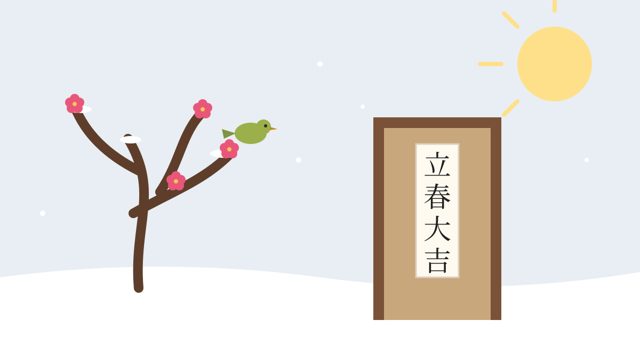
- Post a "Risshun Daikichi" (立春大吉) paper at the entrance, a custom that started at Zen temples. The four characters look the same from front and back. A popular folk tale says a demon who slips in sees the paper from behind, thinks he hasn't come in yet, and walks back out.
- Drink Risshun-shibori sake, freshly pressed at dawn on Risshun morning and delivered the same day by some breweries.
- Use spring greetings in letters: from Risshun on, polite letters open with "the spring of the calendar" even in the snow.
- Watch for Haru-ichiban (春一番), the first strong south wind after Risshun, announced by weather forecasters.
Four ideas hidden inside Risshun
Bring Risshun home
- Feb 4 — write "Risshun Daikichi" (立春大吉) on a strip of paper with a brush or marker and stick it by the door. It's a lovely piece of calligraphy even if you don't read Japanese.
- Look for one sign of spring today, however small: a bud, a longer evening, a brighter morning.
- Set your anchor. Write "Day 1" on today's date, and mark Day 88 (around May 2) for a check-in on your goals.
- Get a 72-season calendar and read the name of each micro-season when it starts. It takes ten seconds and changes how you see the year.
Things that help with Risshun
FAQ
Is Risshun a holiday? No, it's a calendar day, but it shows up everywhere: on the news, in letters, at temples and in shops.
Does the date change? It's set by the sun's position, so it usually falls on February 4, occasionally on the 3rd or 5th.
What's next on the Japanese calendar
On March 3, families display tiers of dolls for Hinamatsuri, the Doll Festival — a celebration that began as a way to float bad luck down a river. Read that guide next.
Related guides: Living by Japan's 72 Micro-Seasons · The Techo Planner System: Japanese Journaling